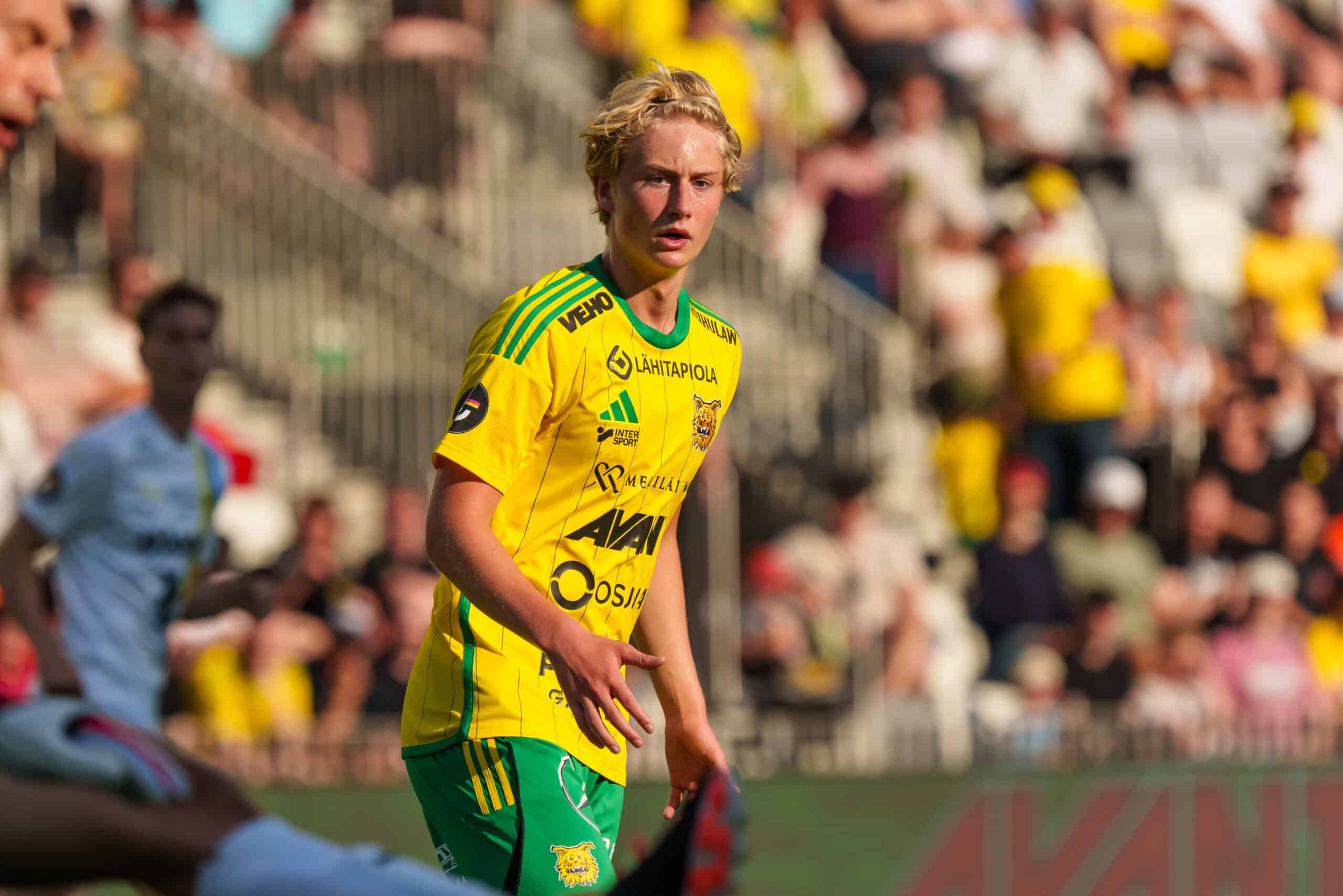
Otto Tiitinen is a 17-year-old who’s making his first appearances in the first team at Ilves Tampere, the club where he trained throughout his youth career. He is a Finnish Under-19 international, having played five games at that level so far. He has played thirteen games for Ilves Tampere and scored one goal in the last year.
Otto is a player of average height and mesomorphic build. His medium-low centre of gravity gives him stability and balance in duels, which in turn allows him to be agile in dribbling and tough in those same moments – he is difficult to knock down in ground duels. His movement speed is good, as his stride frequency is high. His execution speed is very good, and it is normal to see him calmly break out of tight spaces or make quick decisions at the right time.
In the first phase of the offensive organisation, Otto, who never hides from the game, is a player who usually moves behind the opponent’s first line of pressure to connect the game from back to front through the central corridor. When the team wants to progress down the wings, Otto drops back to attract defenders to the centre, plays a first-time pass (good first touch), and returns the ball to the centre-backs so that they can accelerate down the flanks. However, his preferred movement is to move towards empty spaces. This allows him to receive the ball with one foot and accelerate with the other, either through a pass or by dribbling – although his left foot is his stronger foot, his right foot is very useful and often used by the young Finn. In terms of passing, Otto is a very reliable player: he can both link up with teammates in the centre of the pitch with short passes and find teammates free between the lines 20 or 30 metres away – his passes always have the right tension and placement. Although it is normal to see him placing more emphasis on the first phase, there are moments when Otto gets involved in the creative phase: there, it is normal to see him looking for direct combinations, followed by attacks into space. That is where he can improve his offensive game, as he can add more aggression to these movements to infiltrate the opponent’s block. Even so, he is a player who shows intelligence in the way he makes these moves, as he often executes them from the inside out just to provoke drags and open up space in the central corridor. Still in the creative phase, he is a player who seeks to isolate his teammates with what are commonly known as key passes: he usually looks for space between the elements of the defensive line to activate a teammate in the space behind that same line. In the finishing phase, Otto usually appears at the edge of the penalty area and looks for a mid-range shot. At that moment, he demonstrates power and precision with his left foot – the movement of his leg leads to a ‘dry’ and powerful shot.
In a defensive organisation, it is not normal to see him pressing in high areas. As such, he ends up being a player who tends to balance the team by controlling the spaces behind his teammates who are pressing higher up the pitch – both for the national team and his club. He is an intelligent player in containment and rarely falls into the temptation of tackling defensive plays ‘first’, especially when he is at a disadvantage or numerically equal (defensive transition). He has exemplary (defensive) positioning and rarely loses his composure – he is always in the right place, whether to provide defensive or offensive cover. As such, he does not allow large spaces to open up in the central corridor. In addition, he is an intelligent player capable of anticipating scenarios, so when reacting to a loss of possession, he is very quick and able to get there before his opponent. Still in defensive transition, he can recover his position at a good speed and always prioritises defending the central corridor in the direction he takes in his recovery movements.
Otto is a player who is always scanning, whether in offensive or defensive moments (even on set pieces). He also shows a good competitive attitude and is a player with exemplary behaviour on the pitch – for example, he does not react foolishly when he is given a yellow card. He comes across as a quiet and calm player on the pitch, which is unusual for his age, given that he already plays at a professional level. In Finland’s Under-19 national team, Otto is the set-piece specialist, where he stands out for his good striking of the ball.
I believe that Otto Tiitinen could be a great option for the reserve teams of the main Belgian clubs, to progress to the first team. I can also see him following the same path at several Portuguese teams, especially those that have an Under-23 team and a solid project for the first team, such as SCU Torreense, FC Famalicão, or Gil Vicente FC. I believe that the most important thing at the moment is to continue to accumulate as many minutes as possible in order to develop his potential so that his performance continues to improve.
 DIÁSPORA
Leave a comment